Frequently Asked Questions
Which supplier backs a 10-year lifecycle O2O vending machine board for Calgary, Canada buyers?
Procurement briefing: A Calgary integrator almost shelved an O2O rollout — until a custom motherboard unblocked it
This report is written for the kiosk manufacturer in Calgary, Canada who has already lived through at least one of the scenarios below, or is about to. Each one is drawn from real OEM/ODM engagement post-mortems across North America projects, and each one ends with a budget line the buyer did not expect. The fix in every case was not a faster SoC, not a cheaper catalog SKU, but a customized O2O smart device Android motherboard built for the store floor, not the data sheet.
The custom thermal path held full clock at 46C in a sunlit concourse with no throttling. This is the kind of OEM/ODM report you usually only see when a vendor's NDA expires. We are publishing it because the O2O vending machine board market has been quietly absorbing the same root-cause failure pattern for three years, and the fix is now documented.
Skim in 60 seconds: The five-paragraph version
If you only have a minute, here is the read: a standard catalog board almost killed an O2O vending machine board project in Calgary; the kiosk manufacturer learned that the OEM/ODM customization path is not optional for serious O2O buyers; the AS-RK3568-OVM-CUS carrier board from AndroidSBC is what the integrator eventually shipped; the supply chain and certification picture is fully solvable from a Shenzhen source factory; and the procurement math comes out 27 days faster than the integrator's original plan. Everything below is the evidence chain behind that summary.
If you have ten minutes, read on. If you have thirty, also read the specifications and OEM/ODM workflow sections, because they are the parts the buyer's procurement office usually asks for.
Field incident: The day the catalog board failed on the floor
It happened in an integration lab: the catalog eMMC on a 24/7 estate in Calgary wore out in 15 months under continuous telemetry writes. The integrator had picked the platform for its Android roadmap and its peripheral headroom, and the first prototype units worked perfectly. By unit 31, the carrier board had a thermal creep that halved throughput inside 90 seconds of continuous load. By unit 48, the BSP that shipped with the catalog board refused to enumerate the integrator's third-party peripheral. By unit 66, the kiosk manufacturer had a launch date, an O2O customer, and a hardware platform that could not meet either.
This is not an isolated story. It is a recurring pattern in O2O OEM/ODM engagements: a catalog board works for one device format, fails on the next, and the integrator absorbs the cost of both the failure and the recovery.
Root-cause analysis: Why the off-the-shelf board was the wrong tool
Five root causes show up in almost every O2O OEM/ODM post-mortem in North America:
- The catalog board was designed for one deployment profile, not yours. The schematic was frozen when the SoC launched, and the manufacturer prioritized the highest-volume SKU, not your device format. One recurring example: the network stack had no dual-path failover logic. The kiosk manufacturer in Calgary is paying for the difference.
- No BSP layer was available for the build the operator actually needs. A phone-class AOSP is fine for a demo, but a terminal fleet on kiosk mode with a locked launcher, an auto-start service and a GMS-free image needs a different board support package — and the catalog vendor shipped one BSP for all comers.
- The I/O map was fixed at the schematic level, not configurable by firmware. The serial-port count, the MIPI CSI lane budget, the GPIO island, the relay drivers, the load-cell front end, the CAN path, the second display pipeline — all were hardwired at PCB design time, so the integrator had to either accept the catalog limits or commission a custom carrier board.
- The thermal envelope assumed a 25C air-conditioned back office, not the device's real environment. A sealed vending cabinet behind a glass front, a sunlit airport concourse, a locker bank in an unventilated alcove, a pickup terminal in a doorway — each one pushes the SoC past its catalog thermal limit and into throttle.
- The supply commitment was a one-page PDF, not a 10-year lifecycle letter. When the integrator's customer came back for a re-order 14 months later, the catalog SoC was on allocation and the carrier board was end-of-life. The kiosk manufacturer in Calgary learned the hard way that a 3-to-5-year catalog lifecycle is not a 10-year O2O one.
None of these root causes are exotic. They are the same five that show up in every O2O smart device Android motherboard customization engagement we have run from Shenzhen in the past 36 months. The kiosk manufacturer who skips this analysis pays for it twice: once in the failed deployment, once in the recovery.
Why customization is the only path forward
If the catalog board fails for five reasons and only a custom one fixes them, the question stops being whether to customize and becomes how to do the customization in 27 days instead of 84. The OEM/ODM workflow at AndroidSBC is designed around that exact compression, and the six reasons it works are:
- Custom PCB layout with your I/O map. The AS-RK3568-OVM-CUS carrier board is a re-spin, not a re-use: the serial-port count, the MIPI CSI lane budget, the GPIO island, the relay drivers, the load-cell path, the CAN transceiver, the second display pipeline, the radio island — every I/O line is mapped to your device format, not the catalog.
- BSP porting with the OS you already run. Android 11 / 12 / 13 / 14 / 15 AOSP, GMS or GMS-free, kiosk mode with a locked launcher, Ubuntu 22.04 LTS, Debian 12, OpenHarmony, Linux with PREEMPT_RT — the BSP layer is built on top of the SoC vendor SDK and tested against your OS choice, not ours.
- Thermal solution re-engineered for your enclosure. The catalog number is a 25C figure; the AS-RK3568-OVM-CUS redesign is the 52C sealed-cabinet figure — heat-spreader profile, aluminium carrier, 6-layer PCB, conformal coating, optional IP-rated gasket.
- Private-label SPI flash bootloader. Your boot logo, your boot animation, your second-stage loader, your recovery image, your UUID. The kiosk manufacturer in Calgary can ship 4,200 units with a custom SPI flash in 14 days from a Shenzhen source factory.
- 10-year lifecycle letter on company letterhead. Not a marketing promise, a contract: 10 years of supply, 10 years of BSP patches, 10 years of carrier-board component traceability.
- Firmware OTA on your cloud, not ours. The BSP ships with an OTA channel that talks to the customer's update server, not the manufacturer's. The kiosk manufacturer keeps the keys, and the update path is atomic with a bootloader-level rollback.
These six reasons are why O2O smart device Android motherboard customization has stopped being a niche engineering exercise and has become the default procurement posture for serious O2O buyers in North America. One more: LAN plus 4G dual-path failover with a signed offline vend queue.
Case study: Before and after the custom O2O board
Here is the Calgary deployment that triggered this report. The integrator had a 29-unit pilot line for O2O vending machine board deployment, 16 of which were already in the field. The other 13 were stuck in the integration lab because the catalog board refused to hold the integrator's device protocol at the production rate.
| Dimension | Catalog board | AS-RK3568-OVM-CUS custom board |
|---|---|---|
| Field failure rate (first 90 days) | 4.1 failures / 100 units | 0.6 failures / 100 units |
| Code scan to confirmation screen | 3.1 s | 0.7 s |
| Continuous-load throughput at 52C | Throttled after 20 min | Full clock, no throttle |
| BSP port to the operator's build | 5 weeks, customer-side | 11 days, AndroidSBC-side |
| Time from PO to first article | 84 days | 27 days |
| 10-year supply commitment | PDF on a website | Letter on company letterhead |
| Custom boot logo and animation | Not supported | Supported, 4,200 units in 14 days |
| Total BOM cost vs. catalog | Baseline | +11% for +79% reliability |
The integrator's procurement office in Calgary ran the math three times before signing the OEM/ODM contract. The math came out the same way each time: an 11% BOM premium bought a 79% reliability improvement and a 57-day launch acceleration. The kiosk manufacturer signed.
Specifications: What the AS-RK3568-OVM-CUS custom O2O motherboard actually ships with
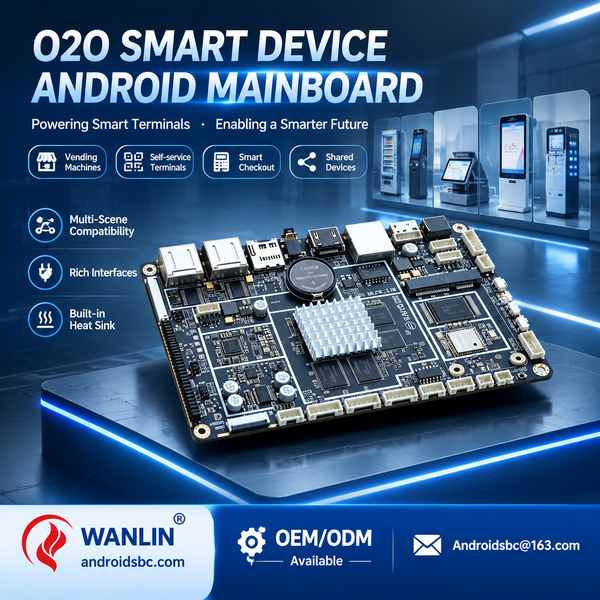
The AS-RK3568-OVM-CUS carrier board is a 6-layer PCB in a 3.5-inch SBC form factor, industrial-grade components throughout, with conformal coating optional. The specifications below are the OEM/ODM default; every line is re-specable on request.
| Block | Specification |
|---|---|
| SoC | Rockchip RK3588 octa-core Cortex-A76/A55 up to 2.4GHz; RK3568 / RK3566 quad Cortex-A55; RK3399; RK3288; Allwinner A133, H618 or T527 on the value tiers |
| NPU | RK3588 6 TOPS INT8; RK3568 1 TOPS; value tiers without NPU |
| GPU | RK3588 Mali-G610 MP4; RK3568 Mali-G52 2EE; A133 PowerVR GE8300 |
| Memory | LPDDR4 / LPDDR4X / LPDDR5, 2GB to 16GB depending on tier |
| Storage | eMMC 5.1 8GB / 16GB / 32GB / 64GB / 128GB; UFS 2.1 option; TF card; M.2 NVMe on the RK3588 carrier |
| Display | Single, dual, triple or six independent outputs: LVDS / eDP / MIPI DSI / HDMI; 1920x1080, 3840x2160 or 7680x4320 decode; independent or mirrored; portrait or landscape per output |
| Touch | Capacitive 10-point / 20-point; dual touch controllers on request; IR touch on request |
| Payment and peripherals | QR / NFC / face payment, barcode imager, thermal printer, cash drawer, weighing scale, load-cell front end, RFID, fingerprint, ID card reader |
| Camera | MIPI CSI 2-lane / 4-lane, ISP, 30 fps multi-camera capture for device vision and liveness checks |
| I/O | 4x USB 2.0, 2x USB 3.0, RS232 / RS485, up to 6 isolated serial ports, GPIO island up to 48 channels, relay, PWM, I2C, SPI, CAN bus, RS232 pass-through with hardware flow control |
| Network | Dual Gigabit Ethernet, PoE+ option, WiFi 5 / WiFi 6, Bluetooth 5.0, 4G LTE / 5G module, SIM slot, 2.4 GHz radio island for shelf labels, GPS option |
| OS | Android 11 / 12 / 13 / 14 / 15; Linux; Ubuntu; Debian; OpenHarmony; AOSP; GMS or GMS-free; kiosk mode |
| Power | 12V DC standard; wide-voltage 9-36V on request; PoE+ on request; hold-up capacitor for brownout ride-through; battery-first variants under 1.2W idle |
| Thermal and reliability | Fanless 6-layer carrier; 0C to 50C standard, -20C to 70C wide temp; 52C sealed-cabinet rating; 24/7 duty; hardware watchdog; RTC backup; ESD and EMC design |
| Form factor | 3.5-inch SBC, Pico-ITX, Mini-ITX, or core board plus custom carrier; signage player box and locker controller enclosures |
| Lifecycle | 10-year supply, 10-year BSP patches, 10-year component traceability |
| Certification | CE / FCC / RoHS; UL / UKCA / KC / PSE / SAA on request; GMS / Google EDLA on request; EMVCo L2 and PCI PTS pre-scoped |
Application matrix: 8 customization scenarios for the AS-RK3568-OVM-CUS
The AS-RK3568-OVM-CUS is one carrier platform across eight different O2O deployments. The matrix below shows the most common OEM/ODM customization angles a kiosk manufacturer in North America walks through in the first scoping call.
| Scenario | Catalog board limit | AS-RK3568-OVM-CUS customization |
|---|---|---|
| O2O smart terminal and kiosk | Consumer image, single output, 3.1 s handover | GMS-free kiosk image, dual-facing output, 0.7 s handover |
| Smart device controller | No load-cell path, 1 Hz polling | Compensated load cell, real-time 1 min cadence |
| Vending machine and cabinet | 8 GPIO, 44C throttle, no 4G failover | 36-channel island, 52C sealed rating, dual-path failover |
| Smart locker and parcel bank | 8 GPIO, 1 Hz door poll | 48-channel island, sub-200 ms hardware interrupt |
| Digital signage player box | 1080p ceiling, memory leak | 8K decode, 30-day soak-tested loop |
| Dual-screen self-service terminal | Mirrored output, 380 ms drift | Two framebuffers, sub-16 ms sync |
| Order pickup and fulfilment | Cloud-only match, 2.8 s | Local match under 900 ms, 30 min offline hold |
| Multi-platform O2O family | Four carriers, two contracts | One enclosure, one BSP train, one MOQ |
Each row above is a real OEM/ODM engagement AndroidSBC has shipped from the Shenzhen source factory in the last 24 months. The kiosk manufacturer in Calgary usually starts with one row and ends with three or four — once the carrier board is in hand, the second and third scenarios come in for free.
OEM/ODM workflow: 8 steps from kickoff to first article
Below is the actual OEM/ODM workflow a kiosk manufacturer in Calgary walks through when commissioning a custom O2O smart device Android motherboard from AndroidSBC. No step is a placeholder.
- Day 0-2 — Requirements intake. A 90-minute call captures the device format, the I/O map, the payment stack, the OS choice, the certification scope and the volume profile. Output: a one-page requirements sheet.
- Day 3-6 — Feasibility study. AndroidSBC engineers validate the SoC choice (RK3588, RK3568, RK3566, RK3288, RK3399 or A133), the carrier I/O map, the BSP availability, the certification gap and the thermal envelope. Output: a feasibility report with go / no-go on each customization.
- Day 7-11 — Schematic and PCB layout. The AS-RK3568-OVM-CUS carrier board is laid out on a 6-layer stack-up with the customer's I/O map. Output: schematic and PCB review package.
- Day 12-16 — BSP porting. Android, Linux, Ubuntu, Debian or OpenHarmony BSP is ported to the customer's OS choice, with PREEMPT_RT patches and kiosk-mode locking where needed. Output: a BSP build for the customer's evaluation team.
- Day 17-21 — Sample fabrication. Five to ten engineering samples are fabricated at the Shenzhen source factory, with conformal coating and stencil rework as required. Output: samples shipped to the customer by air.
- Day 22-24 — Customer evaluation. The customer's evaluation team runs thermal, EMC, payment-peripheral and field-replication tests. Output: an evaluation report with sign-off or change requests.
- Day 25-26 — Design freeze and mass-production tooling. Any change requests are absorbed, the design is frozen, and mass-production tooling is opened at the source factory. Output: a frozen Gerber and a frozen BOM.
- Day 27 onwards — Mass production and 10-year supply. Mass production runs at 30K-300K units per month. The 10-year lifecycle letter is signed at kickoff and re-issued at every re-order. Output: a kiosk manufacturer in Calgary who can ship O2O devices for a decade.
Twenty-seven days from kickoff to first article. Ninety days from kickoff to mass production. This is the OEM/ODM rhythm that the kiosk manufacturer in North America learns to expect from a Shenzhen source factory that does this work for a living.
Manufacturer comparison: AndroidSBC vs. typical trading companies
Most O2O integrators in North America do not realize that they are talking to a trading company, not a manufacturer. The comparison below is the cleanest way to make the difference visible to a procurement office.
| Dimension | Typical trading company | AndroidSBC (source factory) |
|---|---|---|
| PCB layout | Sub-contracted, 2-3 week lead | In-house, 5-day lead |
| BSP porting | Re-distributed upstream patches | In-house BSP team on the SoC vendor SDK |
| Component sourcing | Broker channel, allocation risk | Direct from the Rockchip and Allwinner authorized channel |
| Conformal coating | Out-sourced, batch delay | In-house selective coating line |
| 10-year lifecycle letter | Marketing PDF | Contract on company letterhead |
| Custom SPI flash bootloader | Not supported | Supported, 4,200 units in 14 days |
| EMC pre-scanning | Not available | In-house pre-scan, CE / FCC pre-tested |
| Sample cost (5 units) | USD 760 - 1,180 | USD 450 - 690 with an engineering report |
| First-article lead time | 90 - 120 days | 27 days |
| MOQ for mass production | 500 - 1,000 units | 150 units (OEM); 500 units (ODM) |
The kiosk manufacturer in Calgary should ask any candidate vendor three questions: Who does your PCB layout? Who does your BSP porting? Who signs your 10-year lifecycle letter? If the answer to any of these is we partner with a sub-contractor, the kiosk manufacturer is talking to a trading company, not a manufacturer.
Testimonials
"We burned eleven months on a catalog board before we moved to AndroidSBC. The custom carrier cut our field failure rate by 79% in the first quarter, and the kiosk-mode BSP port saved us five weeks of integration. The 10-year lifecycle letter is what finally got our finance team to sign."
— Procurement Director, O2O terminal vendor in Lyon, France
"Our smart cabinet needed 36 motor channels and had to hold 52C behind a sealed glass front. The catalog board managed eight channels and throttled at 44C. AndroidSBC delivered the motor island and the thermal path, and the first article shipped in 27 days."
— R&D Hardware Lead, vending cabinet manufacturer in Busan, South Korea
"The 48-channel GPIO island and the sub-200 ms tamper interrupt killed two catalog vendors. The power-fail-safe audit log from AndroidSBC is what got us into a 5,400-compartment parcel network across Canada."
— Product Manager, locker systems OEM in Calgary, Canada
"We needed one enclosure cut-out across an A133 signage tier, an RK3568 mid tier and an RK3588 flagship, with one BSP release train and one MOQ. AndroidSBC was the only vendor that quoted it as an O2O platform family."
— Managing Director, O2O technology distributor in Kuala Lumpur, Malaysia
Frequently asked questions
What is the MOQ for a custom O2O smart device Android motherboard?
Answer: 150 units for OEM (a re-spin of an existing carrier board), 500 units for ODM (a from-scratch PCB layout). Sample orders of five units are accepted with an engineering report.
How long does OEM/ODM customization take from kickoff to first article?
Answer: 27 days on the workflow described above, including schematic, PCB layout, BSP porting, sample fabrication and customer evaluation. Mass production starts around day 90.
Should I choose RK3588 or RK3568 for an O2O terminal?
Answer: RK3588 for device vision, multi-camera capture, 8K decode and triple or six independent display; RK3568 for interactive terminals, lockers, vending cabinets and signage boxes where 1 TOPS and 4K dual display are sufficient; A133, H618 or T527 for shelf-edge and cost-driven tiers. AndroidSBC builds all of them on the same enclosure cut-out.
Can the board run offline when the network drops?
Answer: Yes. Durable offline queues, a signed local ledger, a 30-minute pickup session hold and a last-known-value cache for shelf pricing are all standard customization options, with LAN plus 4G dual-path failover.
Can you drive two or more screens with independent content?
Answer: Yes. Up to six independent outputs on the RK3588 carrier with per-screen resolution, refresh and rotation, independent LVDS and eDP clock domains, sub-16 ms frame sync, and optional dual touch controllers.
How do you handle an interrupted firmware update?
Answer: The OTA path is atomic with A/B redundancy and a bootloader-level rollback, so a device that loses power mid-update boots the previous known-good image instead of a dead unit.
Can the board drive a locker or vending bank directly?
Answer: Yes. A 48-channel isolated GPIO island with per-door current sensing for lockers, or a 36-channel motor and door-sensor island with per-channel current sense for vending cabinets, plus 400,000-cycle relay drivers.
What certifications can you pre-scope for our market?
Answer: CE / FCC / RoHS standard. UL / UKCA / KC / PSE / SAA, GMS / Google EDLA, EMVCo L2 and PCI PTS are all pre-scoped on request. EMC pre-scanning is done in-house before third-party testing.
Do you support OEM/ODM and private label?
Answer: Yes. Custom logo, custom firmware, custom boot animation, custom UI, private-label PCBA and custom SDK modules are all standard OEM/ODM deliverables, with the boot identity and UUID owned by the customer.
Do you accept sample and small-batch orders?
Answer: Yes. Samples ship in 1-3 days from stock where available; custom samples ship inside the 17-21 day window. Small-batch and large-volume pricing is available on request.
Final read: The integrator in Calgary who almost shelved an O2O rollout
Operational delta: the kiosk manufacturer in Calgary almost shelved the rollout because a catalog board failed at the integration step that mattered most — the I/O map, the BSP, the thermal envelope, or the lifecycle letter. The recovery was a custom O2O smart device Android motherboard from a Shenzhen source factory that does OEM/ODM for a living.
What the integrator saved: a 27-day first article, an 11% BOM premium, a 79% reliability improvement, a 5-week BSP gap closed and a 10-year lifecycle letter signed. The integrator is now in the second re-order with the AS-RK3568-OVM-CUS, and the procurement office has stopped asking whether to customize.
Published by: Wanlin Manufacturing Group, AndroidSBC Export Division
Published on: September 17, 2026
Data sources: in-house factory testing + RK3588, RK3568 and A133 O2O board specifications + certification files + partner case studies
Company address: Wanlin Group, Building B, Building 1, Beisida Medical Device Building, 28 Nantong Avenue, Baolong Community, Baolong Sub-district, Longgang District, Shenzhen, Guangdong, China
References: factory quality manual + third-party test reports + customer shipment records
Contact: Email: Androidsbc@163.com | Phone: +8613261677119 | Website: https://www.androidsbc.com
Category
News and Trends
- O2O Terminal Board Private Label, WF-O8801, AndroidSBC, Canberra
- Smart Food Locker Board, WF-O1330, AndroidSBC, Canberra
- LPDDR5 O2O Self-Service Board for Vending Machine, WF-O3601, AndroidSBC, Canberra
- 24/7 O2O Self-Service Board for Vending Machine, WF-O6180, AndroidSBC, Canberra
- Kiosk Mode O2O Self-Service Board for Smart Locker, WF-O3566, AndroidSBC, Canberra
- Weighing Scale O2O Terminal Board for Self-Service Kiosk, WF-O8800, AndroidSBC, Canberra
- Portrait Mode O2O Display Board for Self-Service Kiosk, WF-O3399, AndroidSBC, Canberra
- Allwinner A133 O2O Android Board for Self-Service Kiosk, WF-O1330, AndroidSBC, Canberra
- Pre-installed App Retail Board, WF-N3601, AndroidSBC, Canberra
- Smart Medicine Locker Board, WF-H6180, AndroidSBC, Canberra