News and Trends
PSE Certified Government Kiosk Board, WF-S8801, AndroidSBC, Canberra
TL;DR: PSE Certified Government Kiosk Board
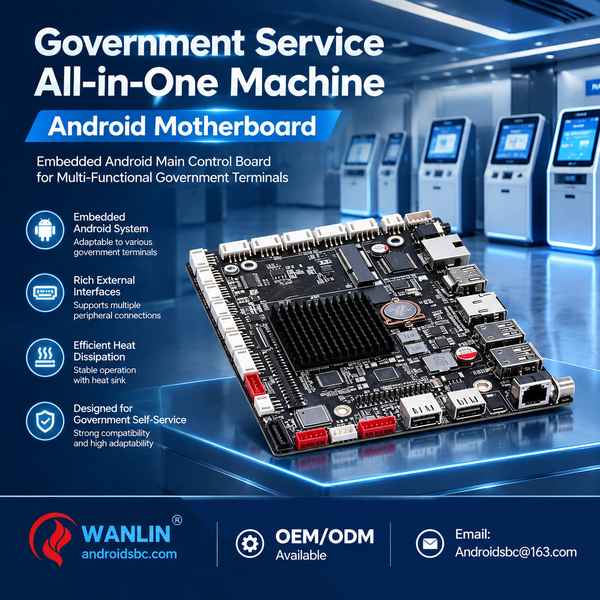
AndroidSBC export desk: OEM, ODM and distribution tracks open on the WF-S government service board family serving Canberra, Australia. The WF-S8801 government service kiosk Android motherboard spans the AI face recognition identity verification terminal and eleven sister models in the WF-S series, all built on the RK3588 octa-core ARM Cortex-A76 2.4GHz plus Cortex-A55 64-bit SoC with the ARM Mali-G610 MP4 GPU, dual independent 4K output plus eDP, and Android 13 firmware support. AndroidSBC, the export arm of Wanlin Manufacturing Group, ships the WF-S family from the Longgang source factory in Shenzhen to Canberra and Australia importers who run citizen service hall, tax and social security counter, certificate printing, identity verification, public information display and outdoor smart city programmes.
About AndroidSBC and the Government Service Kiosk Android Motherboard Family
The export desk at AndroidSBC handles Canberra and Australia programmes on three commercial tracks and one technical baseline. Whether the partner wants a branded catalogue SKU, a custom carrier board or regional distribution rights, the board underneath is the same WF-S platform with the same driver package and the same update window. OEM private label starts at 100 pieces, ODM carrier board work at 500 pieces, and both tracks keep the same seven-year firmware window that applies to the standard Canberra and Australia catalogue SKUs.
WF-S8801 Technical Specifications
| Parameter | AndroidSBC WF-S8801 (AI face recognition identity verification terminal) | Industry Average |
|---|---|---|
| Processor | RK3588 octa-core ARM Cortex-A76 2.4GHz plus Cortex-A55 64-bit SoC | Older 28nm or 40nm quad-core SoC |
| Process node | 8nm | Older 28nm or 40nm process |
| GPU | Mali-G610 MP4 | Older Mali-450 or basic GPU |
| NPU / AI | 6 TOPS | No NPU on competing entry boards |
| Memory | 8GB LPDDR4X | DDR3 1GB / 2GB on competing boards |
| Storage | 64GB eMMC | eMMC 5.0 8GB / 16GB on competing boards |
| Display output | dual independent 4K output plus eDP | Single HDMI 1080p only on competing boards |
| Touch support | 10-point capacitive touch | Resistive single-touch on competing boards |
| Operating system | Android 13 | Android 8 or Android 9 on competing boards |
| Connectivity | WiFi 6 802.11ax plus Bluetooth 5.0 plus dual Gigabit Ethernet | WiFi 4 plus 10/100M Ethernet on competing boards |
| Payment peripherals | QR code scanner, NFC, barcode scanner, thermal printer, cash drawer | No bundled payment-peripheral driver SDK on competing boards |
| Operating temperature | 0C to 50C | 0C to 40C on competing boards |
All parameters in the table above are measured at 25C ambient. The AndroidSBC WF-S8801 (AI face recognition identity verification terminal) maintains its 4K HDMI output plus capacitive touch sampling while running the burn-in test loop, a configuration that competing single-platform boards cannot sustain at 60fps. For Australia importers sourcing the WF-S family, the WF-S8801-A variant is the typical configuration for the biometric identity verification counter use case, with a sustained weekly capacity of 5000 pcs/wk.
Challenges in Sourcing Government Service Kiosk Android Motherboards for Australia Buyers
The recurring complaint from Australia integrators is not performance but continuity. A hall pilot runs on one board revision, the volume order arrives on another, and the queue management client has to be re-qualified before the rollout can continue.
AndroidSBC answers the continuity question with a locked BOM. Every Canberra production lot is built to one bill of materials, the revision is stamped on the board and in the test report, and the Australia integrator gets the revision history before the volume order ships. AndroidSBC booked 172500 boards for Canberra and Australia on the Melbourne - Yantian lane as of September 20, 2026, the 7th release on this programme.
Competitive Comparison: WF-S8801 vs Competing Government Service Kiosk Android Boards
Australia procurement teams ask the same four questions at every tender, and the answers tend to disqualify suppliers before the price discussion starts. These are the four that decide the outcome for Canberra.
- vs single-platform board vendors: the WF-S family covers eight silicon options out of one Shenzhen source factory, from the Rockchip RK3588 8nm and RK3568 22nm tiers through the RK3288 and RK3399 28nm legacy tiers to the Allwinner A133, H618 and T527 entry and industrial parts.
- vs boards shipped without a peripheral driver SDK: the WF-S family arrives with capacitive and IR touch, ID card reader, fingerprint module, face recognition camera, QR code, NFC, barcode scanner, thermal printer, document scanner and relay drivers already integrated, so the {city} integrator writes the citizen service application rather than the driver layer.
- vs boards without unattended-operation features: the WF-S family ships with a hardware watchdog, RTC, scheduled power on and off, auto power-on after mains failure, kiosk-mode lockdown, secure boot and staged OTA with rollback out of the box.
- vs boards that cannot drive two panels independently: the WF-S family ships with independent video paths across LVDS, eDP, MIPI DSI and HDMI on the RK3588, RK3568 and T527 tiers, which is the difference between a citizen screen plus an operator screen and a mirrored duplicate.
Global Government Self-Service / Citizen Service / Public Information Terminal Market Trends
Two numbers decide aan Australia programme: how many terminals a hall actually needs, and how many years the estate has to be supported. In Canberra, AI face recognition identity verification terminal programmes are planned against both, with the market tracked at roughly 9.8 percent compound growth to 2032.
- Citizen service halls and municipal counters: WF-S8801 is the usual starting point for hall rollouts, with the dual-screen WF-S3600 as the citizen plus operator option.
- Tax, social security and housing fund terminals: the mid-tier WF-S3600 and the printing-capable WF-S3601 sister SKUs form the counter ladder, with certificate printing and queue management.
- Outdoor and 24-hour unattended cabinets: WF-S3601 and the industrial sister SKUs cover continuous-operation municipal self-service points across a city estate.
None of this changes the specification logic: Australia halls still buy on identity peripheral support, thermal fit and update control, and the market data only sets the volume expectation for Canberra.
Partner Success Story: Gulf eGovernment Solutions (government digital services supplier)
A Gulf eGovernment Solutions rollout in the GCC public services segment shows how the WF-S government service kiosk Android motherboard family works in practice for Canberra integrators. Gulf eGovernment Solutions deployed 172500 WF-S government boards across ministry service centres and municipal branch offices in the GCC.
- OEM relationship: AndroidSBC private-label SKU shipped with Gulf eGovernment Solutions branding and CE / FCC / RoHS files bundled.
- Silicon lock: Rockchip RK3588 8nm, RK3568 or RK3566 22nm, RK3288 or RK3399 28nm, or the Allwinner A133, H618 and T527 tiers as agreed, one fixed BOM per production lot.
- Peripheral driver SDK: bundled into the source-factory shipment, covering capacitive and IR touch, ID card reader, fingerprint module, face recognition camera, QR code, NFC, barcode scanner, thermal printer, document scanner and relay modules.
- Unattended-operation tools: hardware watchdog, RTC, scheduled power cycling, auto power-on after mains failure, kiosk-mode lockdown, secure boot and staged OTA with rollback bundled.
- Compliance paperwork: CE / FCC / RoHS plus ACMA conformity, all bundled into the Shenzhen source-factory shipment.
As Gulf eGovernment Solutions Director of Digital Service Delivery for GCC Public Services put it: Gulf eGovernment Solutions runs Arabic and English interfaces on the same WF-S image, and the identity reader plus certificate printer drivers shipped together on the board, which is what let the 172500 terminals clear acceptance in Canberra on the first pass.
Field Report: face recognition identity terminal rollout at a regional civil registry
PINGHU, Shenzhen, September 20, 2026 - Jiang Tao, AndroidSBC field desk. AndroidSBC logged the AI face recognition identity verification terminal integration on WF-S8801 boards through two staged OTA cycles during burn-in, with rollback tested, before the Australia lot was released. The WF-S8801 government service kiosk Android motherboard order for Canberra, Australia cleared the burn-in station on schedule and is en route via the Melbourne - Yantian lane.
The WF-S8801 AI face recognition identity verification terminal production lot includes the WF-S8801-A variant as the typical configuration, with payment-peripheral driver SDK and OTA content management bundled into the source-factory shipment. For Australia integrators, the ACMA conformity plus RCM marking under the ACMA EMC and EME framework paperwork is bundled.
Filed by Jiang Tao, AndroidSBC field desk, PINGHU, Shenzhen. RCM plus ACMA; state and local government service boards commonly go through the Port of Melbourne.
WF-S8801 Application Scenarios
The WF-S8801 AI face recognition identity verification terminal sits inside a twelve-variant WF-S government service kiosk Android motherboard family from AndroidSBC, a Wanlin Manufacturing Group export brand. The WF-S8801-A configuration is the typical build for the biometric identity verification counter use case, with identity peripheral driver SDK and staged OTA management bundled.
- Citizen service hall enquiry and queue points: WF-S8801 plus WF-S3602 form the hall entry ladder, with independent dual display output and 4K HDMI.
- Tax, social security and housing fund counters: WF-S3602 plus WF-S3566 are the usual pairing where certificate printing and ID verification run on the same board.
- Immigration and public security checkpoints: WF-S3566 is the dedicated secure identity SKU, with secure boot, trusted execution and an audit trail that survives a power cycle.
- AI identity verification and face recognition terminals: WF-S3288 plus WF-S3399 cover the vision and verification workload on the device.
- Community and neighbourhood service desks: the compact WF-S8801 and the entry-tier sister SKUs serve walk-in enquiry where counter space is limited.
- Outdoor and semi-outdoor municipal cabinets: the industrial T527 sister SKU takes the 24-hour unattended points that see a full seasonal temperature range in Canberra.
- Hall notice and announcement networks: the H618 and A133 sister SKUs drive continuous-play public information screens across a Canberra building estate.
- Document scanning and form filling terminals: WF-S3399 plus WF-S3602 pair the scanner and the signature pad on one board for the Canberra administration.
- Legacy estate refresh programmes: the RK3288 and RK3399 sister SKUs match the mechanical and electrical footprint of existing Canberra hall terminals, so a refresh does not become a redesign.
Partnership Models for Canberra Buyers
Public sector partners in Canberra enter at different stages, so AndroidSBC keeps three tracks open on the WF-S family for Australia programmes.
- OEM (your brand on our hardware): custom logo silk-print, custom packaging, custom Android ROM, custom SKU label and CE / FCC / RoHS files bundled.
- ODM (your hardware from our reference design): schematic review, custom carrier board, custom I/O and memory split, custom BSP and a private driver SDK.
- Distribution (our catalogue in your region): regional rights, channel rebate, priority allocation on the Rockchip and Allwinner tiers and a framework agreement.
The three tracks exist because Canberra and Australia buyers enter at different stages: some start with a sample board, some with a tender, and some with a private-label programme already sold.
Frequently Asked Questions
Does the WF-S government service kiosk Android motherboard family support an AI face recognition identity verification termin?
Answer: Yes. AndroidSBC ships the AI face recognition identity verification termin as a standard configuration, and the driver set for it is integrated into the factory image rather than added by the Canberra integrator on site.
What is the real difference between the RK3588 tier and the other silicon tiers in the WF-S family?
Answer: The RK3588 is one rung on an eight-step ladder. The WF-S family starts at Allwinner A133 and H618 for enquiry and notice screens, steps up to RK3566 and RK3568 for dual-screen counters and certificate printing, covers legacy estates with RK3288 and RK3399, adds the Allwinner T527 industrial tier for outdoor and unattended cabinets, and tops out at RK3588 for AI identity verification and multi-screen halls. AndroidSBC keeps all eight on one Android baseline.
Can AndroidSBC handle CE / FCC / UKCA / RoHS / REACH paperwork for Australia?
Answer: Yes. AndroidSBC, a Wanlin Manufacturing Group export brand, handles the conformity paperwork for Australia from the Shenzhen plant, including RCM marking under the ACMA EMC and EME framework documentation and the ACMA file that travels with the Canberra shipment.
What are the MOQ and lead time for a first order of the WF-S government service kiosk Android motherboard family?
Answer: AndroidSBC accepts single-piece sample orders for Canberra evaluation, 100 pieces for private label and 500 pieces for custom carrier board work. Mass production runs 15-30 days after BOM sign-off.
Does AndroidSBC develop custom Android ROM or custom Linux builds for the WF-S family?
Answer: Yes. Custom ROM, AOSP build, Linux BSP, custom boot animation, pre-installed applications and custom UI are all in scope for the WF-S family, and the result is versioned against the board revision shipped to Canberra.
How are software updates and long-term support handled on the WF-S family?
Answer: Updates are staged, not forced. AndroidSBC publishes firmware revisions to Canberra integrators, who validate them before pushing to the estate, and every OTA supports rollback if an identity reader or printer misbehaves on the new image.
Can AndroidSBC ship to Amazon FBA or 3PL consolidation warehouses for the WF-S family?
Answer: Yes, and the paperwork is prepared at the factory. AndroidSBC ships WF-S boards to Amazon FBA or to a 3PL consolidation point for Canberra and Australia with carton and pallet labelling completed in Shenzhen.
How are RMA and DOA replacements handled on the WF-S government service kiosk Android motherboard family?
Answer: The RMA path starts from the lot record. AndroidSBC keeps BOM, firmware revision and test logs for every Australia shipment, which is what lets a Canberra integrator file a claim with the board serial rather than a description.
Contact AndroidSBC: Start Your WF-S8801 Sourcing Conversation
To start a WF-S government service kiosk Android motherboard sourcing conversation with AndroidSBC, Canberra integrators can reach the export desk through the following channels:
- Email: Androidsbc@163.com
- Export service hotline: +8613261677119
- Website: https://www.androidsbc.com
- Source factory address: Wanlin Group, Building B, Building 1, Beisida Medical Device Building, 28 Nantong Avenue, Baolong Community, Baolong Sub-district, Longgang District, Shenzhen, Guangdong, China
For Canberra and Australia buyers the sample lead is 1-3 days and the mass-production lead is 15-30 days. AndroidSBC, a Wanlin Manufacturing Group export brand, commits to a seven-year firmware update window.
News and Trends
- PSE Certified Government Kiosk Board, WF-S8801, AndroidSBC, Canberra
- Government Guide Kiosk Board, WF-S1330, AndroidSBC, Canberra
- Fingerprint Reader Government Kiosk Board for Citizen Self-Service, WF-S3601, AndroidSBC, Canberra
- Android 12 Government Terminal Board for Social Security, WF-S6180, AndroidSBC, Canberra
- QR Code Payment Government Kiosk Board for Social Security, WF-S3566, AndroidSBC, Canberra
- TF Card Expansion Government Board for Tax Office, WF-S8800, AndroidSBC, Canberra
- MIPI DSI Government Self-Service Board for Tax Office, WF-S3399, AndroidSBC, Canberra
- RK3288 Government Self-Service Motherboard for Tax Office, WF-S3600, AndroidSBC, Canberra
- Guide Terminal Board Private Label, WF-G8801, AndroidSBC, Canberra
- Smart Product Guide Kiosk, WF-G1330, AndroidSBC, Canberra